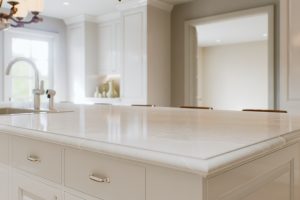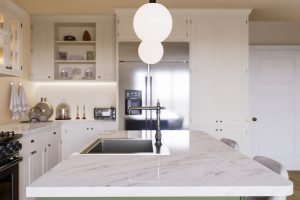


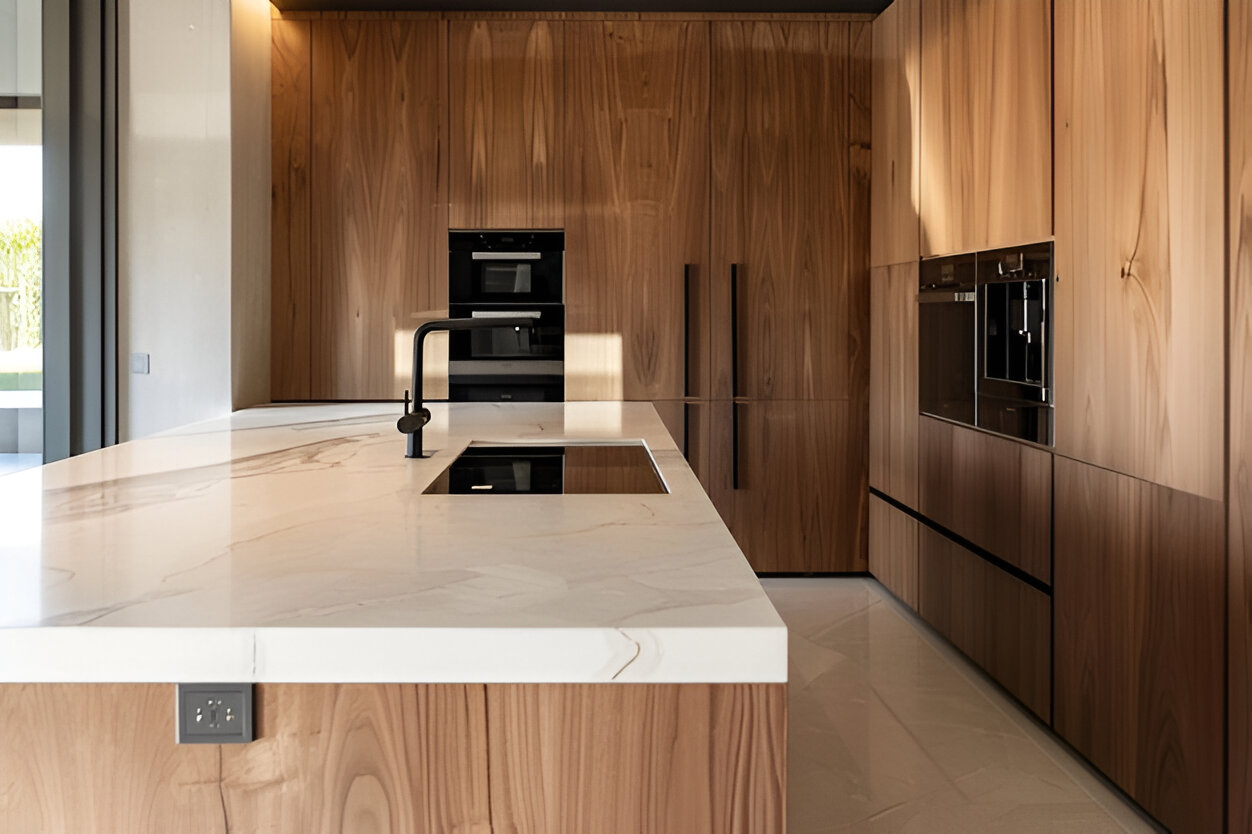

Quartz countertops are a popular choice for homeowners who want a durable, low-maintenance surface with a clean, modern look. Quartz offers strong daily-use performance, consistent design options, and a wide range of colors, patterns, textures, and finishes. These qualities make it a practical choice for kitchens, bathrooms, islands, and other countertop projects. But how much do quartz countertops cost in 2026?
On average, quartz countertops cost $50 to $150 per square foot installed for many standard kitchen and bathroom projects. This usually includes the quartz material, basic fabrication, templating, and professional installation. More detailed layouts, premium quartz brands, waterfall edges, extra cutouts, backsplash work, and difficult site access can raise the final cost to $150 to $200+ per square foot.
If you are planning a kitchen or bathroom upgrade, exploring available quartz countertops can help you compare colors, patterns, finishes, and design options before setting your budget.
For a full kitchen project, many homeowners spend between $2,500 and $7,500+, depending on the size of the space, slab choice, edge style, labor needs, and add-ons. The best way to know the real price is to get a local quartz countertop estimate based on your exact measurements, material selection, and installation details.

What are Quartz Countertops?
Quartz is an engineered stone made from natural quartz minerals mixed with resins, available in a wide range of colors. This is why it’s a perfect choice for versatile and stunning countertops. Most manufacturers of quartz counters make them by using 90% quartz in loose form. The rest of the 10% is actually all resins and pigments.
Quartz Countertops Color Ranges


Size Guide for Quartz Countertops:
Quartz slabs are available in different sizes, and the right slab size depends on your kitchen layout, island size, seam placement, and design goals. Standard slabs work well for many kitchens, while jumbo slabs are often used for larger islands, long countertop runs, or projects where fewer seams are preferred.
Slab Type | Common Thickness | Common Approximate Size |
Standard quartz slab | 2cm or 3cm | Around 120″ x 56″ |
Jumbo quartz slab | 2cm or 3cm | Around 131″ x 64″ |
Jumbo slab does not mean the material is thicker. It usually means the slab is larger in length and width. Most quartz countertops are available in 2cm and 3cm thicknesses, and the right choice depends on your design, cabinet support, edge style, and budget.
Cost of Quartz Countertops Based on Material, Fabrication, and Installation
Quartz countertop pricing becomes easier to understand when the cost is divided into three main parts: the material, the fabrication work, and the installation. A low-cost slab may still become expensive if the layout needs several cutouts, detailed edge work, seam matching, or extra labor.
Here is a simple cost breakdown:
Cost Item | Average Price Range |
Quartz Material Only | $30 – $90 per sq ft |
Fabrication and Installation Labor | $20 – $60 per sq ft |
Typical Installed Quartz Countertop Cost | $50 – $150 per sq ft |
Premium or Highly Customized Projects | $150 – $200+ per sq ft |
Average Full Kitchen Project | $2,500 – $7,500+ |
These numbers are only estimates. Your final price can change based on the quartz brand, slab thickness, color, pattern, edge profile, sink cutouts, backsplash, removal of old countertops, and local labor rates.
Quartz Slab Price by Grade:
The quality of quartz kitchen countertops readily affects the overall price of quartz countertops. So, you can choose the best one according to your budget flexibility. The cost of these countertops is usually based on three grades:
- Low-Grade Quartz: Also known as second-choice quartz, this level is the least expensive. It is strong enough but doesn’t come in many varieties.
- Middle-Grade Quartz: Also known as commercial-grade quartz, the price per level of middle-grade is slightly more expensive than low-grade but comes in more versatile designs than low-grade.
- High-Grade Quartz: It is also known as first choice quartz, and this particular level is the most expensive one. It’s the sturdiest level and comes in an endless range of striking colors, designs, styles, and patterns.
Quality | Cost Per Square Foot |
Low-Grade Quartz Surface Countertop | It ranges from $30-$50 |
Middle-Grade Quartz Kitchen Countertop | It ranges from $50-$80 |
High-Grade Quartz Stone Countertop | It ranges from $80-$150 |
Quartz Countertop Project Cost by Kitchen Size
The size of your kitchen is one of the biggest factors in the final quartz countertop price. Larger kitchens need more material, more fabrication work, and more installation time. Smaller kitchens usually cost less, but the price can still increase if the layout includes an island, detailed corners, sink cutouts, or premium quartz.
Kitchen Size | Countertop Area | Estimated Installed Cost |
Small Kitchen | 30–40 sq ft | $1,500 – $6,000 |
Medium Kitchen | 40–60 sq ft | $2,000 – $9,000 |
Large Kitchen | 60–80+ sq ft | $3,000 – $12,000+ |
These ranges follow the same installed pricing logic of $50 to $150 per square foot, with higher-end projects going beyond that range when premium materials, custom edges, waterfall panels, or extra fabrication work are included.
Quartz Cost Per Square Foot by Brand and Style
Quartz pricing can also change based on the brand, color, pattern, and design style you choose. Standard colors usually cost less, while premium marble-look designs, bold veining, rare colors, and luxury collections can increase the price.
Popular quartz brands such as Cambria, Caesarstone, Silestone, Viatera, HanStone, and Corian Quartz may fall into different price ranges depending on the slab, finish, thickness, and availability. Calacatta-style quartz and other high-end designs often cost more because of their detailed veining and premium appearance.
Brand pricing should be treated as an estimate, not a fixed quote. Your final cost will still depend on the slab selection, countertop size, edge profile, fabrication needs, and installation details.
Quartz Countertop Installation Costs
Quartz countertop installation cost depends on the project layout, number of slabs, cutouts, edge detail, seam work, delivery, and removal of existing countertops. Basic installations usually stay closer to the lower end of the installed price range, while complex kitchens with islands, waterfall edges, backsplash work, or multiple cutouts can cost more.
Common installation-related costs may include:
Installation Item | Possible Added Cost |
Delivery | $150 – $200 |
Old countertop removal | $300 – $450 |
Sink cutout | Around $250 – $300 |
Sink installation | Around $250 |
Backsplash installation | $20 – $40 per sq ft |
Extra labor or custom work | $500+ |
These costs should be added to the main installed pricing estimate only when they apply to your project.
Additional Labor Work:
Some quartz countertop projects need extra labor beyond basic installation. This may include sink cutouts, cooktop cutouts, faucet holes, seam joining, edge smoothing, backsplash work, old countertop removal, plumbing reconnection, or electrical outlet adjustments.
These add-ons can increase the final project cost, especially in kitchens with detailed layouts, multiple cutouts, or old countertop removal.
Electric outlet cutout:
An electric outlet cutout needs to accommodate outlets in your quartz material countertop so that you can enjoy proper functionality and safety. This typically adds an affordable $34 to the total cost.
Radius Corner Or End:
A radius corner or end cut involves rounding the edges of the countertop for a more modern look. This customization usually costs around $202.
Sink Cutout:
A sink cutout is necessary for fitting your sink into the countertop. It usually costs around $278. This price includes precise cutting as well as fitting for various sink styles and sizes.
Sink Installation:
The sink installation includes securing the sink into place and proper sealing. You generally have to pay around $250. This service ensures a functional setup for your kitchen or bathroom.
Backsplash Installation:
Backsplash installation protects your walls from spills and stains. Meanwhile, it adds an extra layer of style to your space. The pricing typically ranges from $20 to $40 per square foot.
Quartz On Cabinet Sides:
Some luxurious kitchen remodeling projects even install quartz around the cabinets of the kitchen island. Thus, this will add a considerable amount to the average installation cost.
Quartz Vs Granite Countertops Cost:
Granite can be more budget-friendly at the entry level, but quartz and granite pricing often overlap. The final cost depends on the slab, brand, thickness, layout, edge profile, cutouts, installation work, and local labor rates.
Granite is a natural stone, so every slab has a unique pattern. It may need sealing from time to time, depending on the stone. Quartz is engineered, which gives it more consistent color and pattern options. It is also low-maintenance and does not need sealing.
Feature | Quartz | Granite |
Material Type | Engineered Surface | Natural Stone |
Typical Cost | Often Mid-Range to Premium | Entry-Level to Premium |
Maintenance | No Sealing Required | May Need Sealing |
Pattern | More Consistent | Naturally Unique |
Heat Resistance | Heat Resistant, Not Heatproof | Generally More Heat Resistant |
Best for | Low-maintenance kitchens and bathrooms | Natural Stone Look and Unique Slabs |
Quartz is not always more expensive than granite, and granite is not always cheaper than quartz. The better choice depends on your budget, design preference, maintenance expectations, and project details.
If you are still comparing both materials, reviewing how granite pricing compares can help you understand the differences in material cost, maintenance, and installation needs.
Quartz vs Quartzite Countertops Cost
Quartz and quartzite are different materials, so their pricing, maintenance, and performance are not the same. Quartz is an engineered surface made with natural quartz minerals, resins, and pigments. Quartzite is a natural stone that is quarried, cut, and finished for countertop use.
Quartzite is often more expensive than quartz because it is a natural stone and may require more fabrication work. It can also need sealing to help protect the surface from stains. Quartz is usually easier to maintain because it does not require sealing and offers more consistent color and pattern options.
Feature | Quartz | Quartzite |
Material type | Engineered surface | Natural stone |
Typical cost | Mid-range to premium | Usually premium |
Maintenance | No sealing required | May need sealing |
Heat resistance | Heat resistant, not heatproof | Generally more heat resistant |
Appearance | Consistent colors and patterns | Natural stone movement |
Best for | Low-maintenance kitchens and bathrooms | Natural stone look and higher heat resistance |
Quartz is a better choice if you want a low-maintenance countertop with consistent design options. Quartzite may be a better option if you prefer a natural stone surface and are comfortable with sealing and additional maintenance.
For homeowners considering natural stone, learning more about quartzite pricing and project costs can help you compare long-term value, maintenance, and installation factors.
Factors That Increase Quartz Countertop Cost
There are multiple factors that will eventually enhance the overall cost of quartz slabs. Therefore, you need to know all the basic countertop price-inflating factors:
- Edge and corner treatments
- Finishing and seaming
- Sink installation and removal
- Other necessary add-ons needed on the spot
Quartz Countertop Edge Treatment Cost
The cost of edge treatment can vary based on the fabricator, edge profile, countertop layout, and the amount of custom cutting required. Some basic edges may be included in the standard project quote, while more detailed edge styles can add extra fabrication cost.
Before choosing your final design, it helps to review different edge styles for your countertop, as the edge profile can affect both appearance and fabrication costs.
Common quartz countertop edge options include:
Straight Edge:
They have sharp corners and straight ends.
Eased Edge:
With little curves around the edge of the countertop
Bevel Edge:
They actually have straight angular cuts of almost 45 degrees around the edges of countertops.
Bullnose Edge:
Bullnose corners are more round and circular in look.
Ogee Edge:
The super wavy, curly, and sharp corners of the quartz engineered countertop.
Edge Shape | Price level | Cost Of Edge Treatment |
Straight light chip edge | Very small rounding of edges | $10-$30 |
Eased | Standard roundness around the top edge | $5-$30 |
Bevel | Straight cutting at 45 degrees on the edge | $20-$45 |
Bullnose | Completely rounded edges from top to bottom | $20-$45 |
Ogee | Super curly cuts on the edges at the top | $30-$60 |
Brand: Premium Brands Command Higher Prices
Such high-end brands of countertops as Caesarstone, Cambria, and Silestone are well-known for their quality, innovation, and diversity of design. These brands tend to have a 10-30 percent markup over smaller, unknown brands or generic brands. What you are paying is:
- Superior quality control
- Extended warranties
- Exclusive designs and colors
- Reputation and customer support
Quality/Grade: Standard, Mid-Range, and Premium
Quartz slabs come in different grades:
- Standard (Builder/Commercial Grade): Basic colors and minimal movement; great for budget-conscious projects.
- Mid-Range Grade: Offers better design options, greater durability, and richer patterns.
- Premium Grade: High-end, often indistinguishable from natural stone. These slabs are more consistent, dense, and stylish—priced at the top of the market.
Color and Pattern: Popular vs. Rare Designs
The simple colors such as white, gray and black colors are generally cheaper and common. Nevertheless, less common or trending designs like Calacatta, Statuario or veined marble-style quartz are more expensive because they are visually complicated and popular. When it comes to a high-end design style, it is likely to cost you more to acquire such fancy designs.
Thickness: 2cm vs. 3cm Slabs
Quartz surfaces typically come in two thicknesses:
- 2cm (¾ inch): More affordable but may require additional support during installation
- 3cm (1¼ inch): Offers a thicker, more luxurious appearance and improved durability, but comes at a higher material and transport cost.
Choosing the thicker option increases upfront costs but may offer better longevity and structural integrity.
Edge Profile: Basic vs. Designer Edges
Edge treatments can affect both the appearance and the price of your countertops:
- Basic edges (eased, straight, beveled) are usually included in the base quote.
- Designer/custom edges (ogee, bullnose, waterfall) require more labor and can add $10–$50+ per linear foot to the project.
Fabrication Complexity: Cutouts, Corners, Seam Work
Intricate countertop designs require more fabrication time and skill:
- Sink and cooktop cutouts
- Angled or curved corners
- Invisible seams and matching vein patterns
Each of these adds to the final fabrication cost. The more complex the layout, the more expensive the build.
Installation Location: Labor, Delivery & Accessibility
Where you live and how accessible your installation site is can significantly impact total cost:
- Urban areas typically have higher labor rates.
- Remote or hard-to-access homes may incur extra delivery fees.
- Multi-story installations may also cost more due to additional handling.
Environmental and Market Trends
In 2026, sustainability and demand are impacting quartz prices:
- Eco-conscious products made with recycled materials or certified for low VOC emissions are gaining popularity, but often come at a slight premium.
- Global supply chain fluctuations and increased consumer demand are also driving pricing volatility across all types of quartz slabs.
Tips for Saving on Quartz Kitchen Countertop Cost
Quartz surface counters are not always a high-end work material; however, there are a few easy options to help you decrease the total price of your project without removing style or deficient work quality. If you are planning to remodel a kitchen or update a bathroom, these tips should serve to make your money go the distance:
Choose Popular, In-Stock Colors or Remnants
The use of standard colors and designs that are easily accessible, including gentle whites, grays or speckled neutral runs, will save you a lot of money. The suppliers usually buy these in-stock slabs in large quantities, hence making them affordable.
On smaller projects, enquire about remnant slabs, leftovers of a larger job. These are usually sold at high discount rates.
Opt for Standard Thickness, Simple Edges, and Fewer Custom Features
Although there are such options as thicker slabs (3cm) and more refined edge profiles, which upgrade the appearance but increase the cost. Standard 2cm slabs and simple edge treatments, such as straight and beveled edges, can reduce both the cost of materials and fabrication.
Another way is to have limited custom cutouts or elaborate designs, which may help simplify fabrication and save on labor costs.
Bundle Installation and Fabrication
Realizing bundle pricing discounts can be easily realized when only one contractor or vendor is used on both the fabrication and installation processes. It also makes communication easier and minimises gaps when making schedules. Request package rates or all quotes so that value is maximized.
Work with Local Suppliers/Installers for Better Rates
Local fabricators often offer:
- Lower delivery and handling costs
- More flexible pricing
- Faster project turnaround
Supporting local businesses can also lead to better service and more customization options compared to big-box chains.
Avoid Specialty Finishes Unless Necessary
Quartz is available in various finishes, polished, honed, and leathered. While honed or textured finishes are stylish, they usually come with extra processing fees. Unless you’re committed to a specific look, stick with the standard polished finish to save money and simplify maintenance.
Are Quartz Countertops Worth the Cost?
With its premium appearance and practical benefits, quartz is one of the most valuable investments for countertops. Here’s why they continue to grow in popularity in 2026:
Durability, Beauty, and Low Maintenance
Quartz is engineered to last. It resists:
- Stains
- Scratches
- Daily-use heat when protected from direct hot cookware
Long Warranties for Peace of Mind
Major quartz brands like Caesarstone, Cambria, and Silestone often back their products with 10–25-year warranties, giving homeowners confidence in long-term performance and support.
Increased Home Resale Value
Quartz worktops are consistently ranked as a top kitchen upgrade among buyers. Their sleek, modern aesthetic adds instant visual appeal, and their low-maintenance nature is a huge selling point. A quartz stone countertop can boost your home’s resale value and help it stand out in a competitive market.
Pros and Cons of Quartz Countertops
Before choosing quartz, it helps to understand both the benefits and limitations. Quartz countertops are durable, stylish, and easy to maintain, but they also have a few drawbacks to consider.
Appearance:
Quartz has an attractive appearance. So, the defining outlook of the quartz stone radiates a very beautiful and attractive appearance. It also gives a very shiny and refined look to the overall kitchen aesthetics. Thus, quartz has either a smooth and hone surface.
Durable:
This great benefit of quartz counters gives a very durable feature to your home’s outlook. Moreover, the surface of the countertop is highly non-porous. This means it will not get stained or cracked. It will also resist spillage from oil, juice, wine, and coffee.
However, they are also scratch-resistant in nature. And it is even more durable than other stones. Thus, it has flexible, strong, and 2x impact resistance.
Easy To Maintain:
The key feature of quartz is that it’s easy to care for and maintain. So, if you want a spotless kitchen, then quartz is just perfect for you. The non-porous nature of quartz is a plus feature. This makes its microscopic pores, which will not let the spills seep in. So, this will resist the stain and spills that occur on them. Quartz kitchen counters are immensely antimicrobial.
Cons Of Quartz Kitchen Counters:
There is a list of cons you must notice before quartz engineered counters. So, below are some of the drawbacks you need to learn.
Vulnerable To Heat:
Quartz is heat resistant for normal daily use, but it is not heatproof. The surface contains resin binders, and direct contact with very hot cookware can scorch, discolor, or damage the countertop. For this reason, hot pans, baking trays, and heated appliances should not be placed directly on quartz.
To protect the surface, always use trivets, hot pads, or heat-resistant mats. With proper care, quartz can perform well in busy kitchens while keeping its clean and polished look for many years.
The Quartz Countertop Installation Process
You need to understand the installation process of quartz surface countertops to ensure a smooth and successful renovation. Let’s have a look at what you can expect from start to finish for your quartz stone surface project:
- Initial Consultation & Measurements: A professional team will visit your space to take precise measurements. This helps you get a perfect fit for your new countertops.
- Material Selection: You’ll have the opportunity to choose the perfect quartz slab for your project according to your preferred color, pattern, and texture.
- Template Creation: You’ll be given a detailed template once you’re done with material selection. This way, your countertop will fit properly into your space.
- Fabrication: The quartz slabs are then cut and finished at the workshop to match your specifications and ensure quality craftsmanship.
- Removal of Old Countertops: The team generally removes the existing countertops the same day as the installation.
- Installation: The installation of your new quartz engineered countertops usually takes 4-8 hours. It totally depends on the complexity of your project.
- Cleanup and Inspection: After installation, the team conducts a final inspection and performs a thorough cleanup to provide you with a spotless area.
- Care Instructions: You’ll then be given care instructions to maintain the beauty and longevity of your new countertops.
Popular Quartz Countertop Brands:
Popular quartz countertop brands include Cambria, Caesarstone, Silestone, Viatera, HanStone, and Corian Quartz. Each brand offers different colors, patterns, finishes, warranties, and price levels. Badger Granite can help homeowners, builders, remodelers, and commercial clients in Milwaukee, WI compare quartz options based on design goals, budget, and installation needs.
Affordable Financing Options for Quartz Countertops
Worried about the upfront cost of quartz material countertops? Are budget concerns holding you back from your dream kitchen or bathroom? You can consider several financing options to make your renovation more affordable:
- Home Improvement Loans: These loans are specifically for renovation projects. You can even find competitive interest rates and flexible terms to fit your budget.
- Home Equity Lines of Credit (HELOCs): Tap into the equity of your home to fund your countertop upgrade. It gives you access to a line of credit with relatively lower interest rates.
- Credit Cards with Promotional Periods: Many credit cards offer 0% interest for 12-18 months. Thereby, you can spread payments without added financial stress.
- Manufacturer Financing: Certain quartz brands offer their own financing programs. This gives you a straightforward way to pay for your countertop in installments.
- Contractor Financing: Some countertop companies offer payment plans that fit your financial needs and make it easier to afford your new countertops. Badger Granite also offers a variety of financing solutions according to your needs.
Visit Financing Options to explore the best financing options and get started today!
Warranty:
Quartz kitchen countertops often come with a 10 to 25-year warranty, depending on the brand, product line, and installer. Always review the warranty details before choosing a slab, because coverage can vary by manufacturer and project type.
Get a Quartz Countertop Estimate in Milwaukee, WI
Quartz countertop cost in Milwaukee, WI can vary based on material availability, fabrication needs, project size, and local installation requirements. A small bathroom vanity top will not cost the same as a full kitchen with an island, waterfall edge, sink cutout, and backsplash.
Badger Granite helps homeowners, builders, remodelers, property managers, and commercial clients compare quartz options based on design, durability, budget, and installation needs. Our team can help with material selection, measurements, templating, fabrication, and final countertop installation.
For the most accurate price, request a local estimate from a countertop supplier in Milwaukee. This gives you a clearer idea of material costs, fabrication, installation, and any additional project expenses before work begins.
Conclusion:
Quartz countertops can be a smart investment for homeowners who want a durable, low-maintenance, and stylish surface for kitchens, bathrooms, islands, and other spaces. The final cost depends on the quartz grade, slab size, thickness, edge profile, fabrication needs, installation work, and add-ons.
For the most accurate quartz countertop cost in Milwaukee, WI, Badger Granite can help you compare materials, review design options, and understand the full project cost before installation begins.
FAQ's
Quartz countertops usually cost $50 to $150 per square foot installed for many standard kitchen and bathroom projects. Premium quartz, custom edges, waterfall panels, extra cutouts, backsplash work, and complex layouts can raise the cost to $150 to $200+ per square foot.
A 10-foot quartz countertop cost depends on the countertop depth and total square footage. Quartz is usually priced by square foot, not only by linear foot. For example, a 10-foot countertop with standard depth may cost around $1,250 to $3,750 installed, depending on the quartz grade, edge profile, fabrication work, and installation needs.
Quartz is not always more expensive than granite. The price ranges often overlap. Granite can be more budget-friendly at the entry level, while quartz may cost more for premium designs, detailed veining, and custom fabrication. The final cost depends on the slab, brand, thickness, layout, edge style, and installation details.
Quartz countertop installation is usually included in the full installed price, which often ranges from $50 to $150 per square foot for many standard projects. Extra work like old countertop removal, sink cutouts, backsplash installation, delivery, and custom edge details can increase the final cost.
Replacing countertops with quartz can cost more than a new installation because it may include old countertop removal, disposal, surface preparation, fabrication, delivery, and installation. Many full kitchen quartz countertop projects fall between $2,500 and $7,500+, depending on the size, material choice, layout, and add-ons.
Engineered quartz countertops usually cost $50 to $150 per square foot installed for standard projects. Since quartz countertops are engineered surfaces, the price depends on the brand, color, pattern, slab thickness, edge profile, and installation complexity.